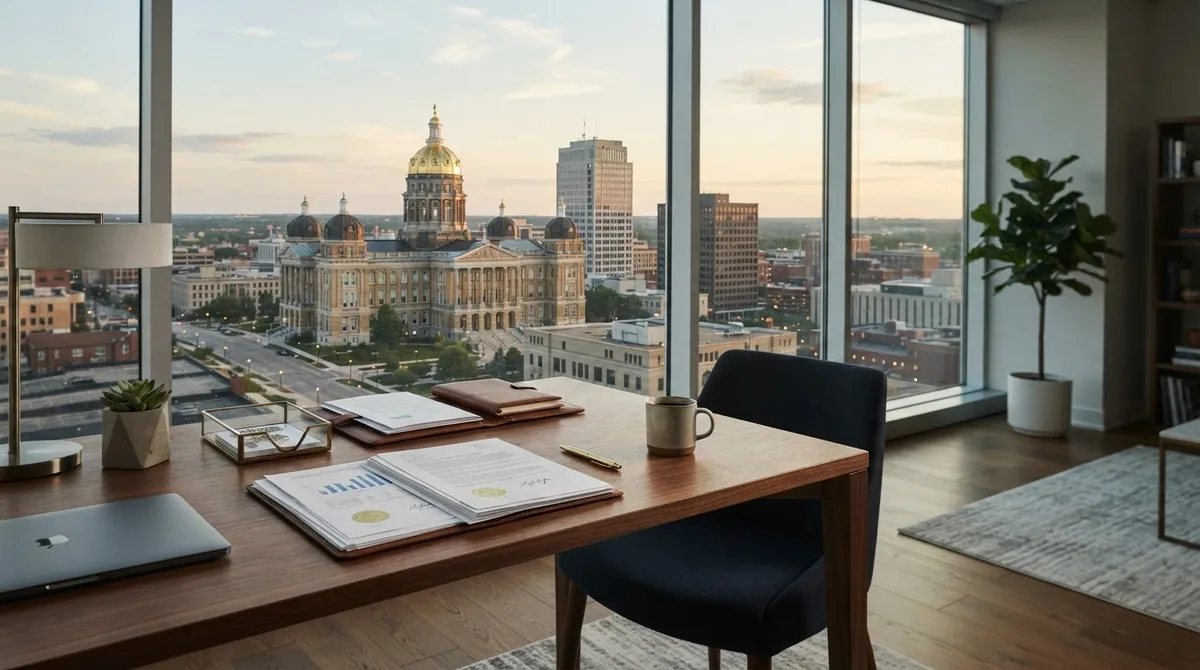
How to Start a Coffee Shop Business in Iowa
How to Start a Coffee Shop Business in Iowa
Opening a coffee shop in Iowa requires balancing paperwork, location strategy, and operational readiness. This guide walks you through each step, from registering your business with the Iowa Secretary of State to serving your first customer. Whether you're a seasoned barista or an entrepreneur new to the industry, the framework is the same: choose your structure, file the required forms, secure licenses, fund your operation, and execute a launch plan.
Step 1: Choose Your Business Structure
You must decide whether to operate as a sole proprietor, LLC, or corporation. Most coffee shop owners choose an LLC because it separates personal liability from business liability and is simpler to manage than a corporation.
LLC vs. Corporation in Iowa
- Limited Liability Company (LLC): Filing fee is $50. You file a Certificate of Organization with the Iowa Secretary of State. An LLC offers liability protection and is taxed as a pass-through entity, meaning profit flows to your personal return and is taxed at Iowa's flat 3.8% individual income tax rate for 2026. Every odd-numbered year (starting in 2027), you file a Biennial Report for $30. No franchise tax applies to LLCs.
- Corporation: Filing fee is $50 for Articles of Incorporation. You pay corporate income tax: 5.5% on taxable income up to $100,000 and 7.1% on income over $100,000 (tax years beginning January 1, 2024 or later). Corporations file a Biennial Report every even-numbered year for $60. If you incorporate, consult a CPA before deciding on this structure, as the tax treatment differs significantly from an LLC.
- Sole Proprietorship: No filing fee with the Secretary of State, but you must still register a trade name (fictitious name) with your county recorder. This structure offers no liability protection; your personal assets are exposed if the business is sued.
For this guide, we'll assume an LLC, which is the most common choice for small coffee shops.
Step 2: Register Your Business Name
Your coffee shop's name must be legally registered and distinguishable from existing businesses in Iowa's records. This involves two separate filings.
Reserving Your LLC Name
Before filing your Certificate of Organization, you can reserve your chosen name for 120 days. The reservation fee is $10. Go to the Iowa Secretary of State's Fast Track Filing portal at https://filings.sos.iowa.gov/ and submit a Name Reservation request. This gives you time to finalize your business plan and secure financing without risk of someone else claiming the name.
Naming Requirements for Iowa LLCs
Your LLC name must include one of these terms: "limited liability company," "limited company," or the abbreviation "LLC," "L.L.C.," "LC," or "L.C." (you may abbreviate Limited as "Ltd." and Company as "Co."). The name must be distinguishable on the Secretary of State's records from all other filed entities, registered foreign entities, and reserved names. Words requiring state agency approval (like "bank" or "insurance") can only be used if you obtain approval from that agency and file it with the Secretary of State. Avoid generic terms; "Iowa Coffee LLC" is likely to conflict with existing businesses, whereas "Timber & Bean Coffee Company, LLC" is more distinctive.
Step 3: File Your Certificate of Organization
Once your name is clear, file your Certificate of Organization with the Iowa Secretary of State. The filing fee is $50. You can file online through Fast Track Filing at https://filings.sos.iowa.gov/ or by mail. Online filing is faster and recommended.
Your Certificate of Organization must include your LLC name, the names and addresses of all members (owners), a registered agent's name and Iowa address, and the effective date (usually the filing date). The registered agent is a person or entity in Iowa who receives legal notices on behalf of your LLC. Many small business owners serve as their own registered agent; alternatively, you can hire a registered agent service for $100 to $300 per year.
Processing time is not published by the Secretary of State, but Fast Track Filing submissions are reviewed and you're notified by email when approved. Status is visible on your Fast Track Filing dashboard. If you need faster turnaround, expedite surcharges are available: $15 for five business days, $50 for two business days, $125 for same-business-day, and $200 for one-hour service.
Step 4: Obtain an EIN and Register for Sales Tax
Once your LLC is filed, apply for an Employer Identification Number (EIN) from the IRS. You do this online at irs.gov at no cost. An EIN is required to hire employees and open a business bank account. Even if you start as a solo operation, getting an EIN separates your personal finances from business finances and is required if you hire anyone later.
Next, register with the Iowa Department of Revenue for a sales and use tax permit. The permit is free. Register at https://revenue.iowa.gov/permits-licensing/business-permit-registration. Iowa's state sales tax rate is 6%. You'll collect this tax from customers and remit it to the state. Most coffee shops collect sales tax and pay it monthly or quarterly depending on sales volume.
Step 5: Secure All Required Licenses and Permits
Iowa does not issue a general business license, but your coffee shop must comply with several specific regulatory requirements.
Food Service License
Contact your county health department to obtain a food service establishment license. This is the most critical permit for any coffee shop. The health department will conduct a final inspection of your facility before issuing the license. You'll need to demonstrate that your kitchen and serving areas meet sanitation standards, that you have proper hot and cold storage, handwashing stations, and documented food safety procedures. Processing time typically ranges from two to four weeks, depending on whether you pass inspection on the first attempt. Expect the license fee to be $100 to $500, depending on your county. Keep the number for your local health department handy; you'll call them with questions as you design your space.
Food Handler Certification
You and every employee who handles food must have a food handler certificate. This is typically a two-hour online course costing $10 to $20 per person. Completion is usually instant, and you receive a certificate to keep on file.
Business Tax Registration
If your coffee shop serves alcohol (for example, selling beer or wine), you'll need a liquor license from the Iowa Alcoholic Beverages Division. A beer and wine license costs roughly $200 to $400 and requires a background check. Full liquor licenses (including spirits) are more expensive and may not be available in all municipalities. Check your local city ordinances before assuming you can sell alcohol.
Building and Zoning Permits
If you're building out a space or making structural changes (electrical work, plumbing, HVAC), you'll need building permits from your city or county. These vary by municipality but typically cost $200 to $1,000 depending on the scope of work. A zoning certificate confirming your location is permitted for food service use is also required. Contact your city's planning or building department early in your site selection process.
Step 6: Create a Fictitious Name Resolution (If Using a DBA)
If your LLC's legal name differs from the name customers will see on signage and menus, you must file a Fictitious Name Resolution with the Iowa Secretary of State. The fee is $5. For example, if your LLC is named "Buchholz Coffee Ventures, LLC" but you're operating as "The Daily Grind," you file a Fictitious Name Resolution for "The Daily Grind." This ensures clarity in official records and prevents trademark confusion.
Step 7: Secure Financing
A typical coffee shop start-up requires $150,000 to $350,000 in initial investment, including lease deposits, equipment, build-out costs, and working capital for the first three to six months. Cost varies based on location, size, and whether you're building from scratch or taking over an existing café.
Funding Options
- Personal savings and credit: Many first-time coffee shop owners invest personal capital combined with a personal loan or small-business credit card.
- SBA loans: The Small Business Administration guarantees loans from banks to small businesses. Iowa has a dedicated SBA district office at sba.gov/district/iowa. SBA loans typically carry lower interest rates than conventional loans and have longer repayment periods (up to 10 years). Application takes four to six weeks.
- Bank loans: Approach regional banks or credit unions. Expect to provide a business plan, personal credit history, collateral, and a down payment of 20 to 30%. Processing time is typically two to four weeks.
- SBDC assistance: America's SBDC Iowa (iowasbdc.org) offers free business planning and financial guidance. They can help you refine your pitch to lenders and review your financial projections at no cost.
Step 8: Find and Lease Your Location
Location is the single most important factor in coffee shop success. You want foot traffic, parking, visibility, and reasonable rent. Aim to spend no more than 10 to 15% of gross revenue on rent. In Iowa cities like Des Moines, Cedar Rapids, and Iowa City, a 1,500 to 2,000-square-foot café space typically rents for $1,500 to $3,000 per month, depending on the neighborhood.
Lease Negotiation Tips
- Negotiate a build-out allowance from the landlord to offset renovation costs.
- Secure a three to five-year lease with renewal options to protect your investment.
- Confirm that the space is zoned for food service and that utilities (water, gas, electrical) can support espresso machines, grinders, and other equipment.
- Have a lawyer review the lease before signing. Lease disputes are expensive to litigate and a legal review costs $300 to $600 upfront but can save thousands.
Step 9: Design the Space and Install Equipment
A functional coffee shop layout includes a point-of-sale counter, espresso bar, grinder station, pastry display, seating area, and restroom. Major equipment includes an espresso machine ($2,000 to $8,000), commercial grinder ($500 to $2,000), brewer for filter coffee ($300 to $1,500), refrigeration ($1,000 to $3,000), and point-of-sale system ($1,500 to $3,000). Smaller items like cups, lids, straws, napkins, and cleaning supplies add another $1,000 to $2,000 in initial cost.
Hire a commercial kitchen designer or contractor if you're building out from scratch. This is not a DIY project. Improper plumbing or electrical work will fail health inspection and cost far more to fix later. Budget $30,000 to $80,000 for build-out (labor, materials, permits) depending on the condition of your space.
Step 10: Order Initial Inventory
Source coffee beans from roasters, either wholesalers or specialty roasters. Many roasters offer wholesale pricing at volume (typically 25 lbs. per bag). Budget $3 to $6 per pound for quality beans. For a 1,500-square-foot café serving 200 to 300 customers per day, order 30 to 50 pounds per week initially. Pastries and food items come from wholesale bakeries or distributors; you can also bake in-house if you have a licensed kitchen and staff trained in food safety. Milk, syrups, and other ingredients should be ordered on a standing basis (usually weekly). Initial inventory typically costs $1,500 to $3,000.
Step 11: Hire and Train Staff
Hire baristas and front-of-house staff at least four to six weeks before opening. Budget two to three weeks for training. Every employee must pass a food handler certification before working with food or beverages. Plan on paying baristas $15 to $18 per hour in Iowa (slightly above minimum wage to attract skilled staff). A 1,500-square-foot café typically needs two to three full-time equivalent staff members, plus part-time coverage for peak hours. Your payroll will be your largest ongoing expense after rent; budget 30% of revenue for labor costs.
Step 12: Market and Launch
Before opening, build awareness. Create a social media presence (Instagram, Facebook) and post about your upcoming opening date, grand opening specials, and your coffee philosophy. Reach out to local media; many newspapers and radio stations cover small business openings. Consider a soft opening (invitation-only or limited hours) for two to four weeks to work out operational issues before your official grand opening. Offer a small discount or free item during opening week to drive initial traffic.
Tips for Success
- Start with a narrow menu: Offer espresso drinks, drip coffee, and a few pastries. Resist the urge to add sandwiches, pizza, or full meals initially. Focus on doing coffee exceptionally well. You can expand later if demand supports it.
- Invest in quality equipment: A cheap espresso machine will frustrate you and your customers. Spend on a mid-range machine ($3,000 to $5,000) from a reputable brand (La Marzocco, Rancilio, Rocket). Quality equipment breaks down less often and delivers consistent results.
- Develop relationships with suppliers: Coffee roasters, milk distributors, and bakeries are partners, not just vendors. Good relationships lead to better pricing, priority access to limited products, and support when you have supply issues.
- Track your cash flow: Coffee shops often operate on thin margins (5 to 10% net profit). Monitor daily sales, inventory turnover, and waste. Many coffee shop owners fail because they don't watch their numbers closely enough in the first year.
Common Mistakes to Avoid
- Underestimating start-up costs: Add 20% to your budget estimate. Unexpected repairs, permit delays, and cost overruns are standard.
- Skipping the business plan: Lenders won't fund you without one, and you need it to stay on track. Spend one to two weeks writing a simple business plan that includes your market analysis, financial projections for three years, and a description of your operations.
- Choosing location based on affordability alone: A cheap space in the wrong neighborhood means empty tables. Pay for foot traffic and visibility, even if rent is higher.
- Neglecting inventory management: Over-ordering leads to spoilage and waste. Under-ordering means running out during peak hours. Use a simple spreadsheet or inventory management software to track usage and reorder points.
- Hiring solely on availability: Your barista is the face of your business. Invest time in hiring people who care about quality and customer service, not just warm bodies to fill shifts.
Expected Timeline and Costs at a Glance
| Phase | Timeline | Cost |
|---|---|---|
| Business registration and licensing | 2 to 4 weeks | $400 to $1,000 (LLC filing $50, food license $100-$500, permits $100-$400) |
| Lease negotiation | 2 to 8 weeks | First month rent + security deposit (typically 1 to 2 months' rent) |
| Build-out and installation | 4 to 12 weeks | $30,000 to $80,000 |
| Equipment purchase | 2 to 4 weeks | $8,000 to $18,000 |
| Initial inventory | 2 weeks | $1,500 to $3,000 |
| Staff hiring and training | 4 to 6 weeks | Training hours (unpaid for most training) |
| Marketing and grand opening | 4 to 8 weeks pre-launch | $1,000 to $3,000 |
| Total | 3 to 6 months | $150,000 to $350,000 |
Ongoing Compliance and Taxes
After you open, remember that you must file a Biennial Report with the Iowa Secretary of State every odd-numbered year (LLCs) or even-numbered year (corporations). The LLC biennial report fee is $30 and is due by April 1. If you miss the deadline, the state may revoke your LLC status, though you typically have a grace period to cure the failure. You must also file income tax returns annually with the IRS (Form 1040-C for sole proprietors, Form 1120-S for S-corp-election LLCs, or Form 1120 for C-corps). Work with a CPA on tax planning; coffee shop owners often overlook quarterly estimated tax payments and end up owing penalties. As your coffee shop grows, consider working with a tax professional to ensure you're taking all available deductions (rent, equipment depreciation, utilities, supplies, payroll taxes).
Resources for Iowa Coffee Shop Owners
- Iowa Secretary of State (business formation): sos.iowa.gov
- Fast Track Filing (online filing portal): filings.sos.iowa.gov
- Iowa Department of Revenue (sales tax, income tax): revenue.iowa.gov
- America's SBDC Iowa (free business counseling): iowasbdc.org
- SBA Iowa District Office: sba.gov/district/iowa
- Business License Information Center: license.iasourcelink.com
- Your local health department (food service regulations)
- Your city or county building and planning department (zoning and building permits)
Disclaimer
This article provides informational guidance on starting a coffee shop business in Iowa and is not legal, tax, or financial advice. Business formation and tax obligations vary based on your personal situation, ownership structure, and local regulations. Consult with a qualified attorney regarding business structure, lease agreements, and licensing requirements. Consult with a CPA or tax professional regarding tax planning, estimated quarterly payments, and annual filing requirements. The fees and processing times stated in this article are accurate as of September 2026 and subject to change; verify current fees with the Iowa Secretary of State, your county health department, and local authorities before incurring costs.